

Allocating Capital to Alternative Investment Funds
With investment options multiplying and markets growing increasingly unpredictable, finding the right balance between growth and stability has never been more challenging. For investors seeking to protect their wealth while still pursuing meaningful returns, a deliberate and diversified strategy is essential.
In this context, Alternative Investment Funds (AIFs) have emerged as an effective mechanism for asset preservation—particularly in periods of economic uncertainty. By reducing reliance on traditional equity and bond markets and providing exposure to real assets, AIFs can support long-term capital protection while addressing inflationary pressures.
Investors focused on safeguarding capital while pursuing sustainable growth may find that AIFs offer diversification and income sources that are typically less sensitive to short-term public market volatility.
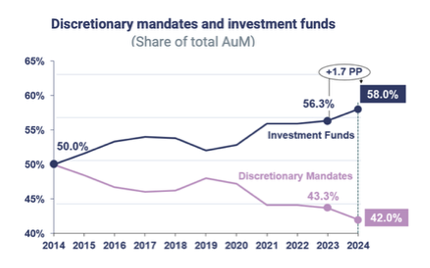
*Investment funds increased their share of total assets under management from approximately 50% in 2014 to 58% in 2024, reflecting investors’ growing preference for pooled, professionally managed vehicles over bespoke mandates.[1]
Rethinking Portfolio Construction with Alternative Investment Funds
Alternative Investment Funds (AIFs) are collective investment vehicles that allocate capital to assets apart from traditional securities such as publicly traded stocks or fixed-income instruments. AIFs generally encompass hedge funds, private equity funds, real estate funds, and commodities. They are intended to generate returns from unconventional asset classes and investing methods that have lower correlation with typical markets.
In Cyprus, AIFs operate within a clearly defined regulatory framework. They are governed primarily by:
- The Alternative Investment Fund Managers Directive (AIFMD) at EU level; and
- Cyprus Law 124(I)/2018, which regulates Alternative Investment Funds and their managers under the supervision of the Cyprus Securities and Exchange Commission (CySEC)
Unlike traditional investment funds, which are subject to more prescriptive investment restrictions, AIF regulation focuses on the authorized Alternative Investment Fund Manager (AIFM). This approach allows greater flexibility in investment strategy and asset allocation, while maintaining strong requirements for governance, risk management, transparency, valuation, and investor protection.
The Strategic Role of Alternative Investments
Alternative Investment Funds are not merely instruments for diversification; they have increasingly evolved into strategic cornerstones for well-informed investors. AIFs provide access to asset classes beyond conventional public markets, including real estate and private equity, while including governance and risk management structures aimed at ensuring long-term stability.
When an AIF is structured with a primary emphasis on direct investment in real estate, investors have exposure to income-generating tangible assets and the prospect of inflation-resistant returns. Real estate serves as a concrete asset within a diversified portfolio, as properties typically retain fundamental value despite market fluctuations. A complementary allocation to private equity can further enhance portfolio balance by selectively capturing growth opportunities, while maintaining real assets as the foundation of the investment strategy.
Diversification and Risk Mitigation
AIFs excel at tailoring investment strategies to specific investor requirements while systematically managing risk. Unlike conventional investment vehicles, AIFs offer greater flexibility in asset selection, allocation, and long-term positioning—making them well-suited for investors who prioritise strategic outcomes over short-term market movements.
Professional fund managers utilize risk-management frameworks that encompass many asset classes and adjust to evolving market conditions. This comprehensive strategy facilitates wealth preservation objectives and assists investors in maneuvering through macroeconomic fluctuations with enhanced assurance.
Performance and Market Growth Trends in Alternative Investments
Although every fund performance differs by strategy and asset class, overarching industry data demonstrates the increasing investor interest and robustness of alternative investing in Europe. Industry reports indicate that the European Alternative Investment Fund market grew to around €7.26 trillion in net assets by mid-2023, demonstrating a steady capital accumulation and a 41% increase since 2015.[2]
Moreover, according to the latest EFAMA Asset Management Report, total assets managed in Europe, including alternative investment funds, reached a record €33 trillion in 2024, reflecting an 11.7 % increase year-on-year.[3] This growth underscores the continued relevance and resilience of collective investment vehicles within the broader investment landscape
Importantly, investment funds, including alternative investment funds, comprised approximately 58 % of total assets under management by the end of 2024, illustrating investors’ increasing allocation to structured and professionally managed investment vehicles.
These overarching trends underscore the magnitude and assurance that well-informed investors attribute to diverse fund structures within long-term asset strategies.
While past performance does not guarantee future results, these trends help demonstrate why many investors consider alternative investments as strategic components in diversified, long-term portfolios.
Cyprus: A Leading Jurisdiction for Alternative Investment Funds
- Prominent benefits for AIFs in Cyprus comprise EU-aligned legislation and oversight, which bolster investor protection and transparency.
- An enabling legislative framework and economical fund establishment and management.
- Strategic geographic position connecting Europe, the Middle East, and North Africa.
- The network of double-taxation treaties and tax-efficient frameworks render Cyprus appealing for cross-border investments.
This amalgamation has facilitated Cyprus’s emergence as a burgeoning destination for cross-border funds in Europe, providing investors with access to broad markets and professional knowledge supported by regulatory assurance.
Final Thoughts
In an environment characterized by economic volatility and fluctuating markets, safeguarding wealth necessitates careful planning and expert management. Well-organized Alternative Investment Funds that emphasize direct real estate investments, alongside a supplementary allocation to private equity, provide investors with an attractive strategy for wealth preservation.
By combining tangible real assets with disciplined governance, strategic diversification, and regulatory alignment, investors can pursue financial resilience and sustainable growth while remaining responsive to changing market and regulatory conditions.
[1] https://www.esma.europa.eu/sites/default/files/2024-01/ESMA50-524821-3095_EU_Alternative_Investment_Funds_2023.pdf, accessed 2nd February 2026
[2] https://funds-europe.com/efama-report-on-aif-market-and-aifmd-review/, accessed 2nd February 2026
[3] https://www.esma.europa.eu/sites/default/files/2024-01/ESMA50-524821-3095_EU_Alternative_Investment_Funds_2023.pdf, accessed 2nd February 2026